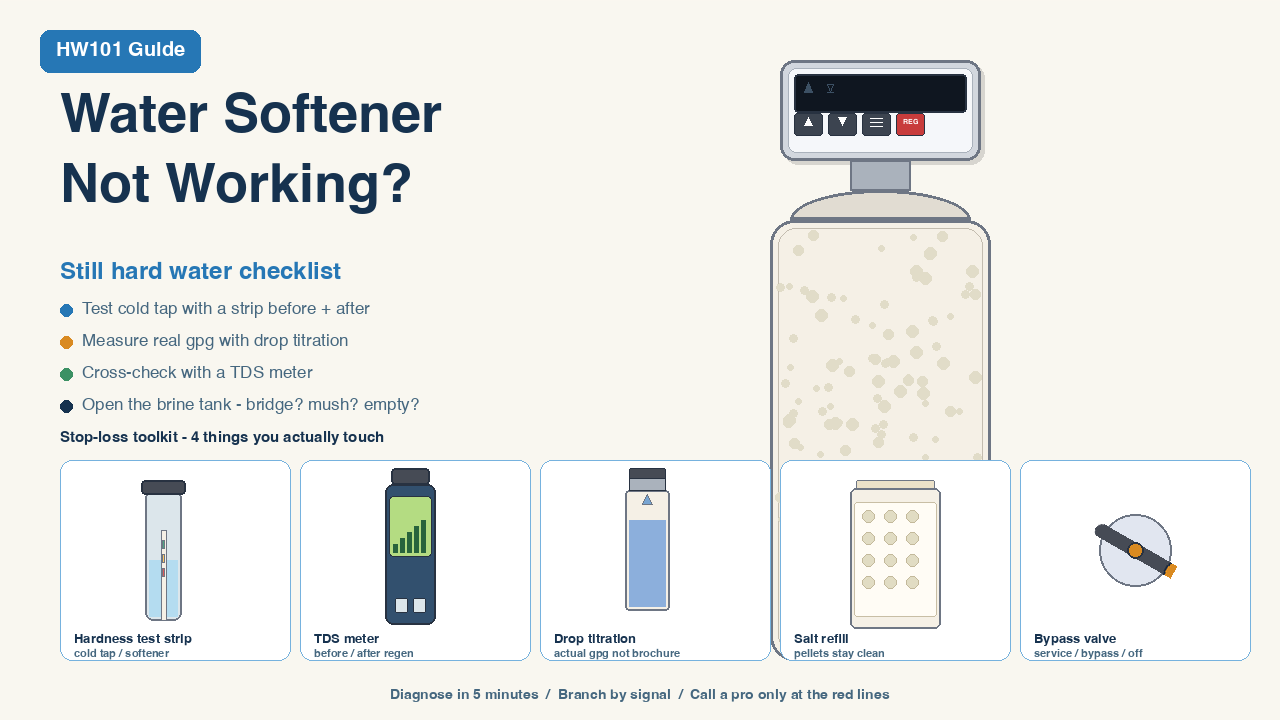
If every glass spots again and the softener “looks fine,” you don’t need a replacement slogan—you need a short path that separates still hard water from the unit never regenerating and salt that never drops.
Quick answer
A water softener that’s “not working” is almost always one of seven things: bypass open, no power after an outage, empty salt or a salt bridge, hardness setting that never triggers regen, cycle that never starts, brine that never draws, or a failed control head. Confirm with a strip at a cold tap and a manual regen button. The page below walks the 5-minute stop-loss, then branches you by signal instead of sending you to buy a new unit.
Do this first (5 minutes)
Stop-loss only. No cleaner dump, no control-head surgery, no shopping for a new softener yet.
Step 1 — Test cold water with a strip
Drop in a budget strip kit before and after the softener. Soft after a known-good cycle means the resin can still work. Hard everywhere = keep going.
Step 2 — Bypass position
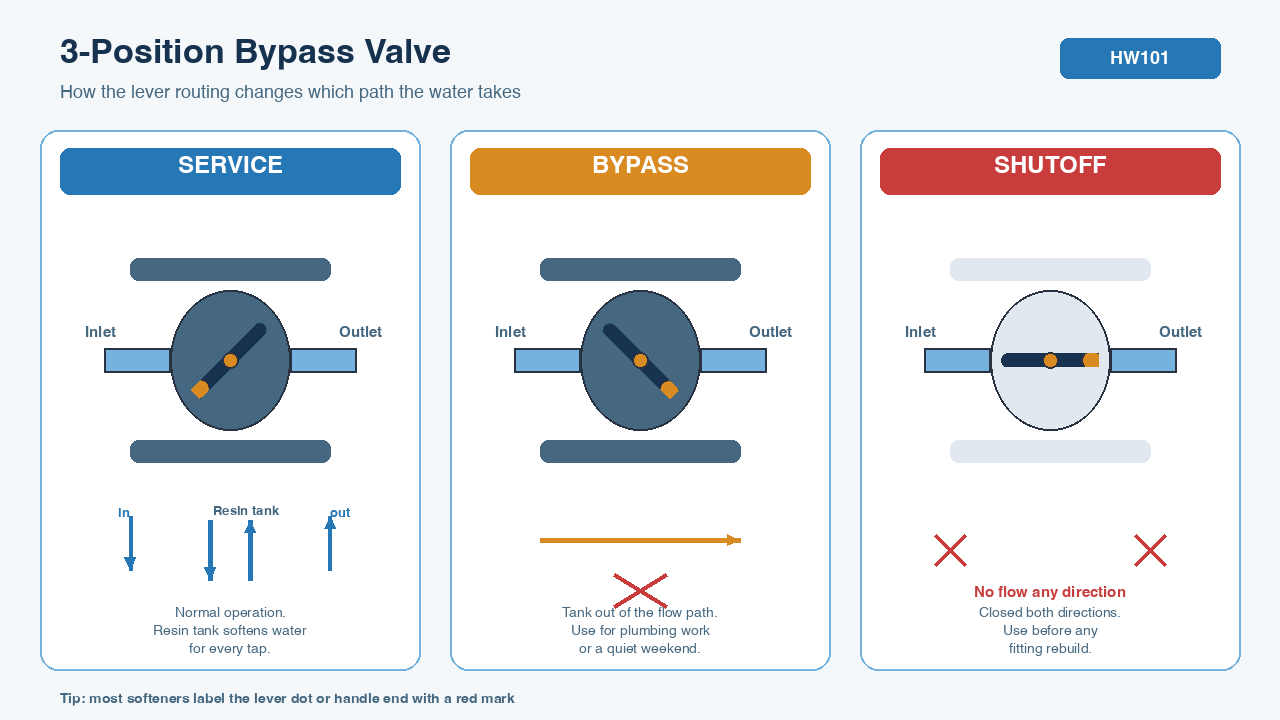
Confirm the valve is in service, not bypass. Most units have a lever or knob — service is the position that lets water through the resin tank. Bypass is the position that routes around the tank.
Step 3 — Power / display / clock
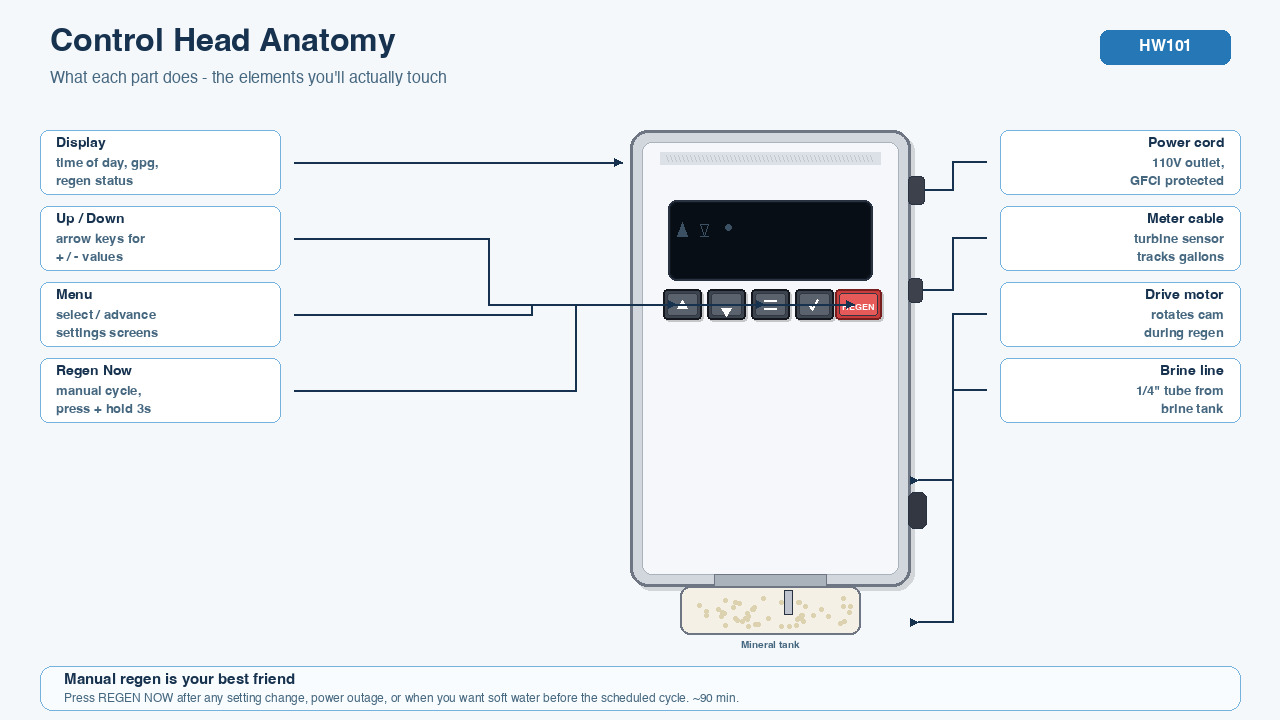
Display lit? Time correct? Outlet live (GFCI reset)? After an outage, the clock often resets to 12:00 AM, which can delay regen for up to 7 days.
Step 4 — Salt level and condition
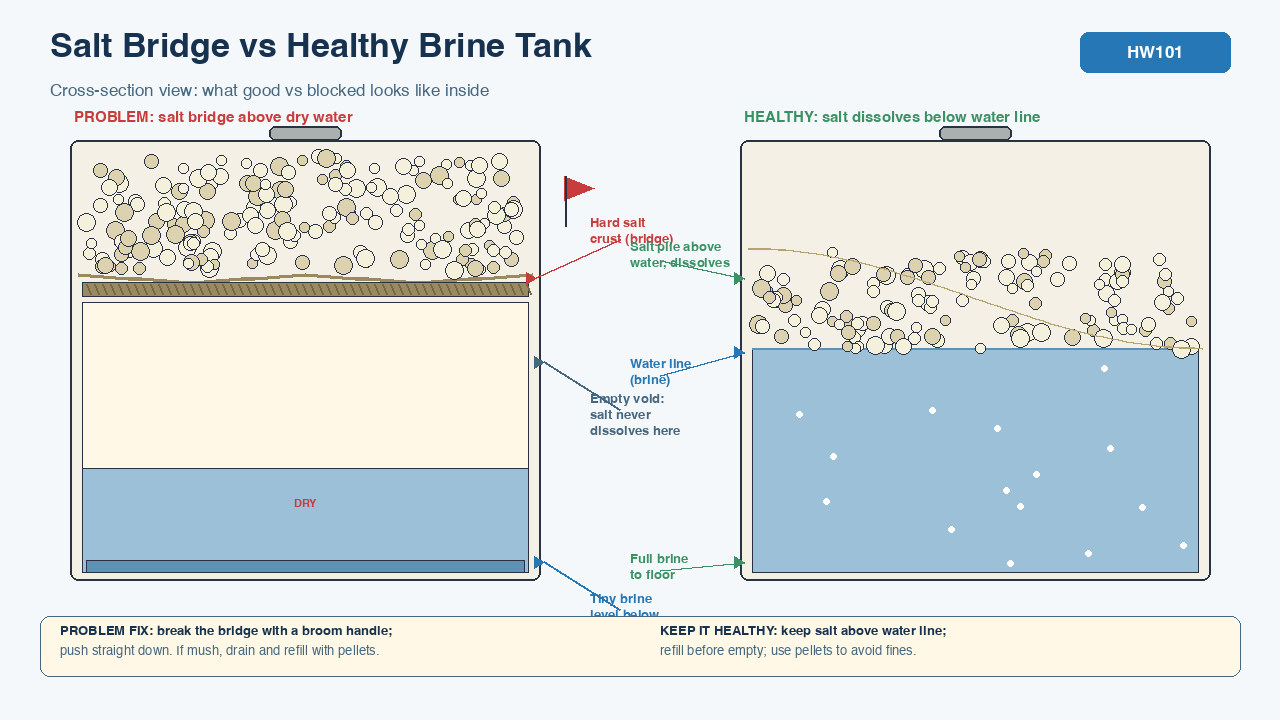
Open the brine tank. Empty → Mode 3. Hard crust or dome shape → Mode 4 (salt bridge). Water above the grid or mush → Mode 7.
Step 5 — One manual regen
Most control heads have a “regen now” or “manual regen” button. Watch whether the cycle runs, whether brine actually drops, and whether it completes within ~90 minutes.
Skip / Don’t do these before Step 5
- Don’t dump cleaner into a tank that hasn’t yet completed one regen — cleaner without working regen can’t clear anything.
- Don’t force a jammed valve mid-cycle. Back-pressure plus the electric drive and bleed port combination can crack the valve body.
- Don’t cut mains water or open pressurized fittings without an explicit plan for shutoff and bypass.
7 failure modes table
Use this table when you have a signal but not a diagnosis. Each row gives the easy test and the typical fix.
| # | Mode | Signal you see | Easy test | Typical fix |
|---|---|---|---|---|
| 1 | Bypass open or leaking | Hard at every tap; salt pile never drops | Flip lever handle; observe change | Close or rebuild bypass — a bypass valve kit replaces the seal and handle |
| 2 | Power outage / unplugged / breaker | Blank display; no night-cycle noise | Plug a lamp into the same outlet | Plug in, reset GFCI, re-set the clock |
| 3 | Salt empty or wrong salt type | Salt below the water line; crystals or pellets loose | Open the brine tank | Refill — a Morton 4-pack covers ~6 months for a typical family |
| 4 | Salt bridge or mushing | Salt level looks full but the pile is intact; surface crust | Push a broom handle down — feel a hard cap? | Break the bridge gently; if mush, drain and refill with pellets |
| 5 | Settings wrong / capacity wrong | All electric signs normal; manual regen completes; soft for less than a day then hard | Compare programmed gpg vs measured gpg with a drop titration kit | Re-program with measured gpg, not city-given |
| 6 | Regen cycle never starts | Display lit; no motor noise at the scheduled time; meter never counts down | Listen for motor or valve click at the scheduled hour | Motor, timer, or meter board — pro service |
| 7 | Brine won’t draw | Manual regen starts but brine in the tank never drops; sticky float or loud injector | Lift the float manually; check drain line flow | Clear the drain, clean the injector, then run a resin cleaner before the next regen |
The seven modes are a synthesis of common troubleshooting patterns from Morton System Saver, Kinetico K-Series, and Culligan Medallist service guides. Most “dead” units fall into one of these rows.
Branch by what you see
If Step 5 gave you a clear signal but no fix yet, pick the branch that matches what you observed.
A — Cycles never start or never finish
Go to /problems/water-softener-not-regenerating/. Typical signals: blank display, no night-cycle noise for weeks, the meter never counts down. The sister guide covers power, motor, timer, meter board, and valve head rebuild in depth.
B — Salt pile never drops
Go to /problems/water-softener-not-using-salt/. Typical signals: brine looks full forever, bridge crust above dry water, the head “runs” but brine never draws. Sister guide covers injector cleaning, drain flow, venturi, and refill cycle logic.
C — Tank water high, mush, overflow, weird brine level
Go to /problems/water-softener-brine-tank/. Typical signals: water to the lid, salt mush, float stuck, overflow to the floor. Sister guide covers float adjustment, brine fill setting, vacuum break, and salt-sock fixes.
D — Manual regen completes but water stays hard
Stay in this guide. This is the diagnostic where we run Mode 5 (settings), Mode 6 (iron-on-resin or TDS mismatch), and cycle-phase checks. Four moves:
- Re-check bypass is truly in service on the whole-house path. A half-closed bypass can let hard water creep through the resin bypass line.
- Retest hardness AFTER cycle end, not mid-cycle. If the softener runs Tuesday night, test Wednesday morning.
- Re-check programmed hardness gpg vs your measured drop test. If city-given says 12 gpg but your drops say 25 gpg, the unit is undersized regardless of regen count.
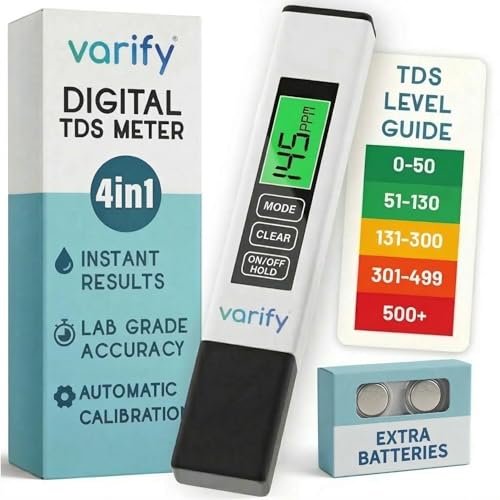
- Cross-check with a TDS meter — read at the cold tap before and after the softener. A drop of 80%+ means the resin is working; a flat reading means it’s not.
If iron or long neglect is likely AND brine clearly draws, treat with Rust Out for iron-fouled resin — not the generic cleaner.
If manual regen cannot draw brine at all or the valve fails under pressure, call a pro.
For how the cycle is supposed to work, read /systems/how-water-softeners-work/. For salt-form choice after you refill, see /essentials/salt-pellets-vs-crystals/. For a wider view of hardness units, gpg vs ppm vs mg/L conversions, and how city water reports compare to your actual tap reading, see /water/water-hardness/.
Branch-by-signal decision tree
Use this when you can’t tell which mode applies. Walk the tree top to bottom.
START — confirm with a strip first
  │
  ├── Is the display dead? ─── YES ──> Branch A (not-regenerating)
  │
  ├── Is salt level actually low? ── YES ──> Mode 3 (refill)
  │                                    NO ──> check bridge ──> Mode 4
  │
  ├── Is there water above the salt? ── YES ──> Branch C (brine tank)
  │
  └── Run manual regen (≈90 min)
      │
      ├── Did regen COMPLETE? ── NO ──> Branch A
      │
      └── Did brine DRAW? ── NO ──> Branch B
                              │
                              └── YES ──> Test after cycle:
                                  │
                                  ├── Hard water, drop test > programmed gpg? ──> Re-program gpg
                                  ├── Hard water, drop test ≤ programmed gpg? ──> TDS cross-check
                                  ├── TDS flat, iron suspected? ──> Rust Out
                                  └── TDS flat, resin 10+ years? ──> Pro service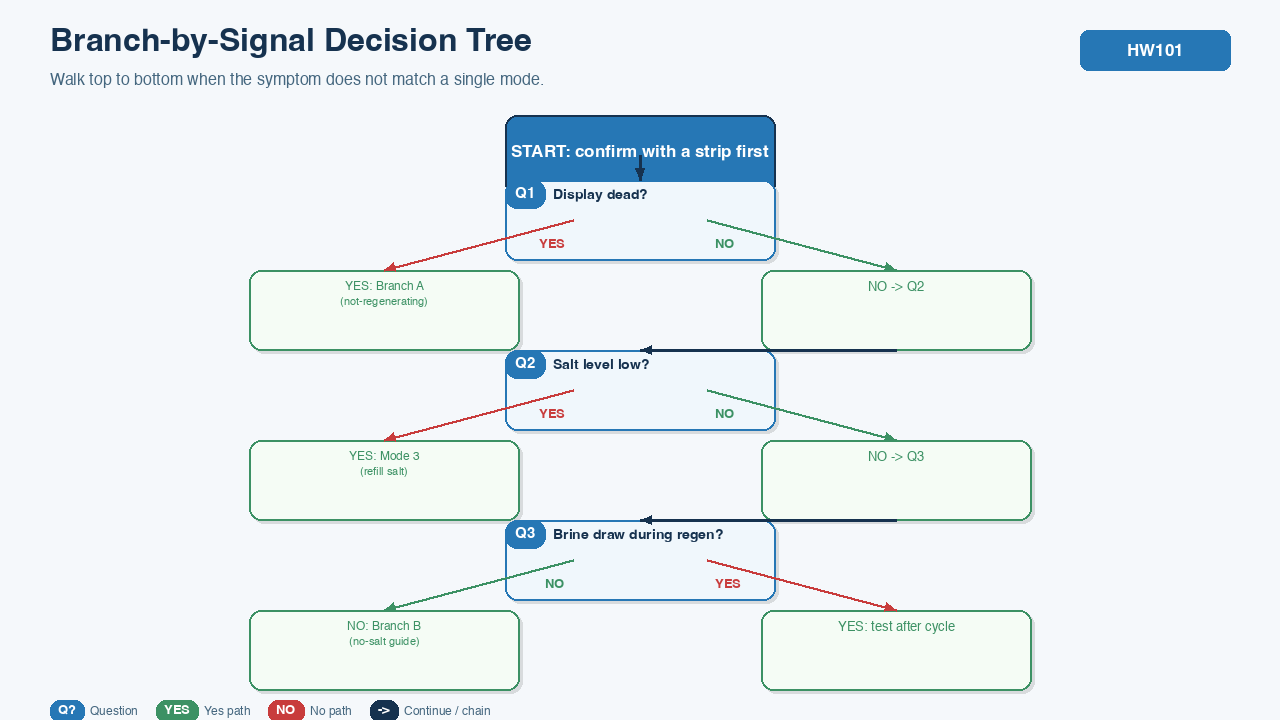
What this page is not
- Not a ranking of which softener to buy.
- Not permission to skip the hardness number — measurement is step zero.
- Not an installer marketplace or a coupon page.
- Not a full parts schematic for every valve brand — see your control-head manual for that.
Safe limits (DIY vs Pro)
- DIY stays on: power plug, GFCI reset, bypass lever, salt level, gentle bridge break, settings screens, hardness strips and drop tests.
- Pro territory: mains cuts, pressurized leaks, burnt electrical smell, failed manual regen after basic checks, valve or motor rebuild.
The line is roughly: if you would have to shut off water to the house and drain pressure before touching it, that’s a pro call.
Common mistakes
- Buying a new softener on day one. Empty salt, a bridge, an open bypass, or a wrong gpg setting cause most “dead” units. Walk the 5-minute stop-loss before any cart action.
- Skipping the hardness number. Strips are step one, but you also need a measured gpg — a drop test or a TDS meter reads your actual gpg, not the city’s brochure number.
- Adding cleaner to a unit that won’t regenerate. Cleaner without a working regen cannot circulate. It just sits in the brine tank. Confirm a full manual regen first, then dose.
- Replacing a whole softener when only the bypass failed. A seized handle or cracked valve body only needs a bypass rebuild kit, not a $1,200 unit.
- Ignoring the post-outage clock reset. If your unit sat through a power outage, the regen timer often resets to 12:00 AM — which can delay the next cycle by a week. Reset the clock and run a manual regen.
- Forgetting to check the bypass after plumbing work. If you had a plumber swap a water heater, replace a toilet, or service a fixture in the last month, the bypass may have ended up half-closed. That’s the single most common “softener stopped working” report we see after any home plumbing visit.
When to call a pro
Call a plumber or softener tech if you hit any of these:
- Mains water shutoff required to diagnose the leak — that’s pressure-side work.
- Pressurized leak at a fitting, valve, or brine-tank connection that you can’t isolate with the bypass.
- Burnt electrical smell from the control head, or a visibly scorched transformer.
- Failed manual regen after basic checks — cycle starts but won’t complete, motor won’t fire, or brine won’t draw even after the drain is clear.
- Valve or motor rebuild — replaceable parts inside the head that need a service kit and a tech who knows the brand.
Related guides
- Water softener not regenerating — cycles that never start or never finish
- Water softener not using salt — salt pile never drops
- Brine tank problems — high water, mush, float stuck, overflow
- How water softeners work — the cycle you should be hearing at 2 a.m.
- Water hardness explained — what gpg actually means
- Hardness test kits — strips, drops, and TDS comparison
- Salt pellets vs crystals — refill form after the bridge is broken
- Softener size calculator — check whether the unit was ever right-sized
Reader questions
The full Q&A sits in the frontmatter _faq block — eight common questions on bypass, salt, regen schedule, and replacement timing. If your specific symptom isn’t in the list above, scan the Related guides for the matching branch, or use the Quick answer plus the 5-minute stop-loss to narrow down which failure mode applies before you order parts.
Key takeaways
- Test before diagnosing — strips, drop titration, and a TDS meter in that order.
- Walk the 5-minute stop-loss before any branch decision.
- Branch by signal: cycles don’t start (A), salt doesn’t drop (B), tank water issues (C), regen completes but water stays hard (D).
- Don’t replace the unit on day one — diagnose the 7 failure modes first.
- Settings matter — drop-test your actual gpg and program the measured number, not the city-given brochure value.